

JLC-DÜSSELDORF
OUR APPROACH
COURSES AND PROGRAMS
All children that come to the JLC – Early Learners, Young Learners, and Teens – receive age appropriate instruction that is both fun and filled with educational value. We make sure to take the time to understand the individual wishes and objectives of our learners and to incorporate them into our classes. Our main objective is that our learners enjoy what they do and look forward to coming to our language school. Combining learners’ individual interests and having fun in the learning process ensures our teaching success.

Early Learners (VYLs) 🖍️
VYLs learn with us with all their senses, for example by combining certain words with a movement or doing thematic arts and crafts. Through this combination of hearing, seeing, feeling, and doing, the learning content is absorbed holistically. The children sing, play, clap, stomp, paint, or do arts and crafts. These different approaches to the foreign language enable a natural, dynamic division of the lesson. Phases of concentration are followed by phases of freedom in the same way that energetic games are followed by quieter activities.
The holistic approach not only focuses on practicing the target language, but on the whole child. Language is experienced through action, play, movement, and perception. For this reason, the children's feelings, experiences, and wishes are also addressed and considered. Story-telling and role plays serve as great ways of actively introducing our early learners to empathy and kindness which are central to social and emotional learning.
📚 Teaching materials: puzzle sheets, hand puppets, songs, picture books, handicrafts, flashcards, coloring, experiments for the senses, games for the senses, matching worksheets, gamified worksheets, movement games, as well as age-appropriate digital resources.
🎯 Aim: The children should develop a feeling for a new language in a playful way and without pressure to perform. Memory, concentration, oral and fine motor skills, and speech rhythm are trained.

Young Learners (YLs) ✏️
IIn our group classes, Young Learners are introduced to typical forms of teaching without experiencing purely frontal teaching, which means that we require a lot of initiative and independent learning. Conceptually, the holistic approach applies to the YLs in the same way that it applies to the VYLs. Here, too, social and emotional learning continues to play a significant role in our curriculum, and we seek to foster empathy, mindfulness and resilience in our YLs. We endeavor to complement their otherwise, continued process of self- and world discovery by integrating concepts such as empathy, environmental awareness, and sustainability.
On the practical side, in addition to sensory perception and learning through doing, the use of writing and the training of self-learning techniques come into play. For example, we practice reading comprehension and strategies in a gamified manner, such as scanning for answers or memorizing facts. Other typical teaching elements such as grammar, sentence structure, listening comprehension, reading skills, text comprehension, pronunciation and written language style are trained in a non- traditional manner, where the students are encouraged to use the structures in a more communicative way than they are used to at school. In addition, the competent use of flashcards, posters, and games, as well as techniques for self- and partner-monitoring are practiced.
📚 Teaching materials: gamified worksheets, puzzle worksheets, song lyrics and music, language games, learning posters, short films, writing games, dictionaries, vocab worksheets, role-playing games, as well as cutting-edge and age-appropriate digital resources.
🎯 Aim: The YLs are introduced to the foreign language in depth; their language skills are gradually expanded, and an independent learning attitude is practiced. In this way, our language trainers teach responsibility for independent learning.
Teens ✏️
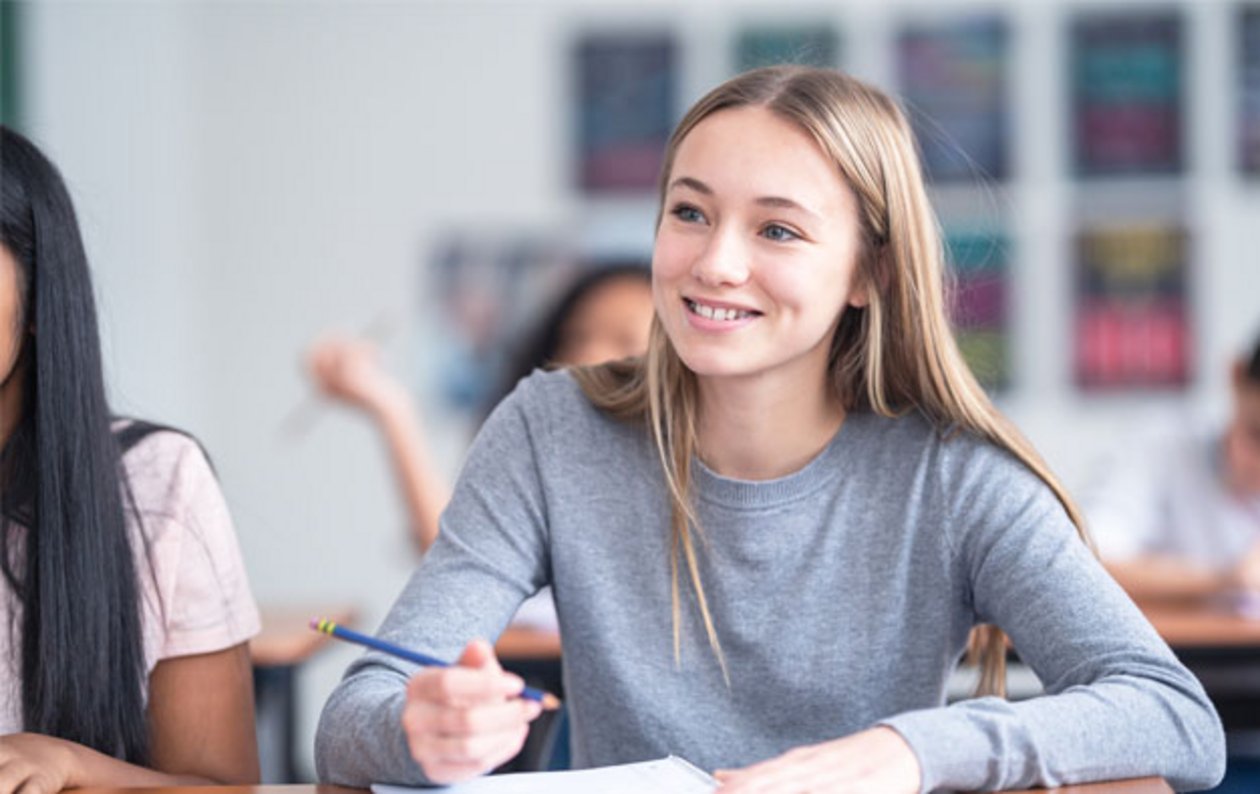
In a nutshell: our school-age learners, who learn the target language at school as a school subject, are given the chance to experience it here as a means of communication. In addition to typical teaching elements, lessons with teenagers focus on speaking and expression skills as well as vocabulary development. Teens are given plenty of room to speak and thus improve their speaking and expression skills, because our native-speaker trainers listen very carefully. Our trainers work increasingly with methods such as role play, discussion rounds, short presentations, film reviews, knowledge quizzes, and interviews. Discussions, projects and debates revolve around important issues such as, for example, the UN Sustainable Development Goals and current global challenges, but also aspects of life that are most relevant and pertinent to their ages and worlds of interest.
We further foster our students’ emotional intelligence, resilience and self-confidence by empowering them to gradually assume more responsibility: for example, we elicit their input as to the topics or projects and, together, incrementally integrate their choices into our curriculum.
📚 Teaching materials: Language games, learning posters, worksheets, short plays, flashcards, song lyrics and music, short films, writing games, media room with computers, materials for independent work, dictionaries, role-playing games as well as cutting-edge, innovative digital resources including VR.
🎯 Aim: The main focus is on giving our teens space and freedom to speak and to simulate everyday situations in dialogs, and to do so without pressure of for-grade performance. The young people's world of interest should serve as a linguistic starting point. The direct relationship between the language and the person means that the learning content is absorbed and integrated in a natural way, which automatically improves communication skills. We endeavor to create communicative situations whereby the teens shake off their inhibitions about expressing themselves verbally in the target language; consequently, their skills and abilities can unfold exponentially.
Our groups are small and consist of 4 to a maximum of 8 participants, which enables a high speaking rate and active participation.
Internationally diverse – our students come from a wide range of educational backgrounds.
Our teachers’ selection of topics and activities for the given learning modules is deeply rooted in our Mission, Vision and Values.
Social and Emotional Learning (SEL) plays an important role in our curriculum and course design, and we are currently in the process of becoming a Certified School of Kindness. In our classrooms, we introduce, foster and nourish fundamental values, such as empathy, inclusion, diversity, multiculturalism, environmental awareness and innovative curiosity. It is our firm belief that, in doing so, we equip our young learners with the tools they need to become empathetic and passionate world citizens of tomorrow.
Our academic team will ensure that you receive your child’s Progress Reports at regular intervals – usually, before the winter break, before the Easter break and before the end of the school year. In addition, we encourage and welcome feedback and engagements from the parents and we will be happy and eager to share with you the many wonderful assignments and projects that our young learners work on throughout the school year.
Reasons why your child is in good hands:
Over 20 Years of Experience
For over two decades, we have been helping children to learn languages through play - with know-how, passion and pedagogical expertise.
Child-friendly Language Concept
Our courses are age-appropriate and combine language with play, movement, creativity and project work.
International, native-speaking teachers
Our teachers come from all over the world and bring authentic language and cultural diversity into the classroom.
Learning with joy - without any pressure to perform
Whether in a course or at camp: with us, children discover languages with fun, curiosity and without the stress of grades. This boosts their self-confidence, motivation and enjoyment of learning.
OUR BONUS FOR YOU
No Registration Fees
Sibling Discount
Referral Bonus
Early Bird Discount
Frequently Asked Questions
Participation in our group courses is only possible after completing our registration form. The information you provide there - age, level in the target language, availability, etc. - is very important to us so that we can invite your child to a trial lesson in an ideally suited group. Alternatively, you can simply call us - so that we can discuss this and arrange a trial lesson directly.
A 10% discount is granted for each additional sibling registered. This policy applies to the second child registered.
The new, referred member will have to indicate the name of the current, referring member in the appropriate field on their online JLC Registration Form. Once the new, referred member completes their registration and starts participating in one of our German group classes, a credit of 30 € will appear on their course fee invoice. The referring member will receive their Referral Bonus in the amount of 30 € – this bonus will be credited to their account and either applied to any course fee due or paid out as a bank transfer. (Important: our Referral Bonus is NOT combinable with our Sibling Discount.)
So, here once again step-by-step:
- You refer us to a friend
- They put your name at the time of their registration in the appropriate field on our Online Registration Form
- They sign up and start attending
- You and our Friend receive a Referral Bonus of 30 € each